
Global Process Transformation: Scaling Content Development Across 17+ Languages
Redesigning a global content development operating model to eliminate duplication, improve scalability, and generate more than $250K in cost savings.
Project Impact
$250K
Reported project cost savings
85%
Content reuse in the initial training manual
17+ Languages
Supported through global localization
Overview
What started as an initiative to improve the efficiency of global training development revealed a larger opportunity to change how content was created, maintained, and distributed across the organization.
At a multinational healthcare company, training teams were developing technical materials for customers, sales teams, and internal employees across multiple products and languages. Existing processes relied on traditional document-authoring tools, resulting in duplicated content, lengthy approval cycles, and significant delays in translation.
The opportunity wasn’t simply to produce training materials faster. It was to create a more scalable and sustainable approach to managing content across the organization.
Challenge
The organization needed to develop technically accurate, compliant training materials while supporting frequent product changes and global distribution.
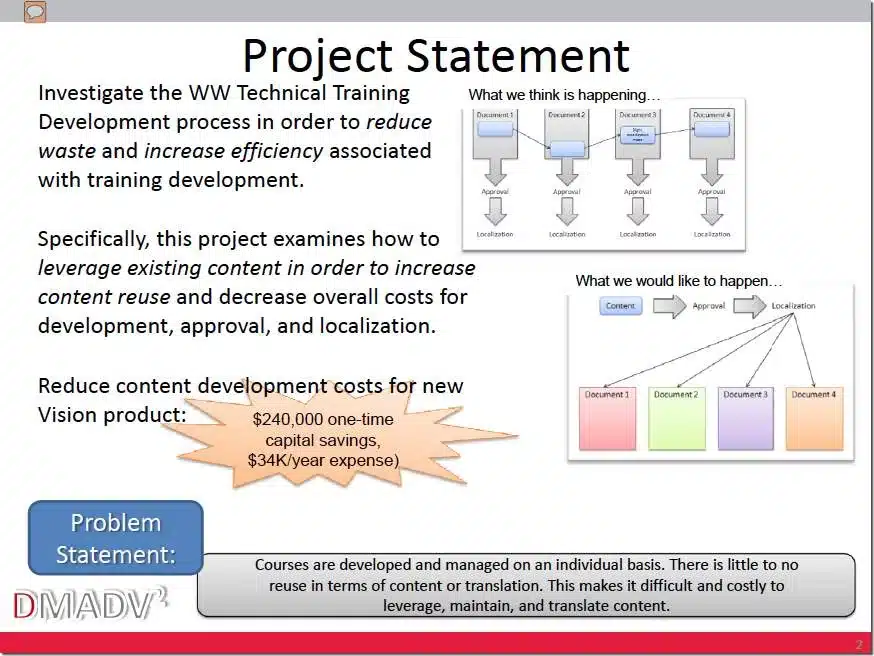
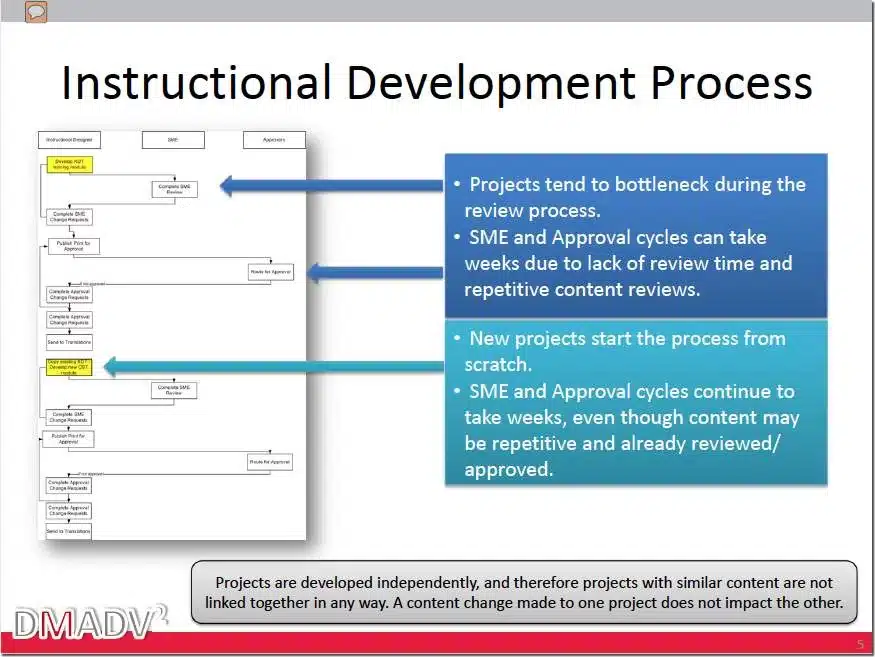
However, content was maintained in separate documents, often requiring the same information to be recreated, reviewed, and translated multiple times.
Translations could lag as much as 12 months behind English-language releases, and the existing process made it difficult to accommodate revisions without adding time and cost.
The organization needed a fundamentally different approach to content development that would improve consistency, reduce duplication, and support faster delivery across global audiences.
My Approach
I led a 2.5-year process improvement initiative, using Six Sigma DMADV methodology to evaluate the existing content development process and identify opportunities for improvement.
Working with cross-functional stakeholders, I examined how content moved through development, approval, translation, and publication. Through process mapping, cost analysis, critical-to-quality requirements, and solution evaluation, I identified opportunities to eliminate redundant work and create a more efficient operating model.
That discovery led to two key areas of focus:
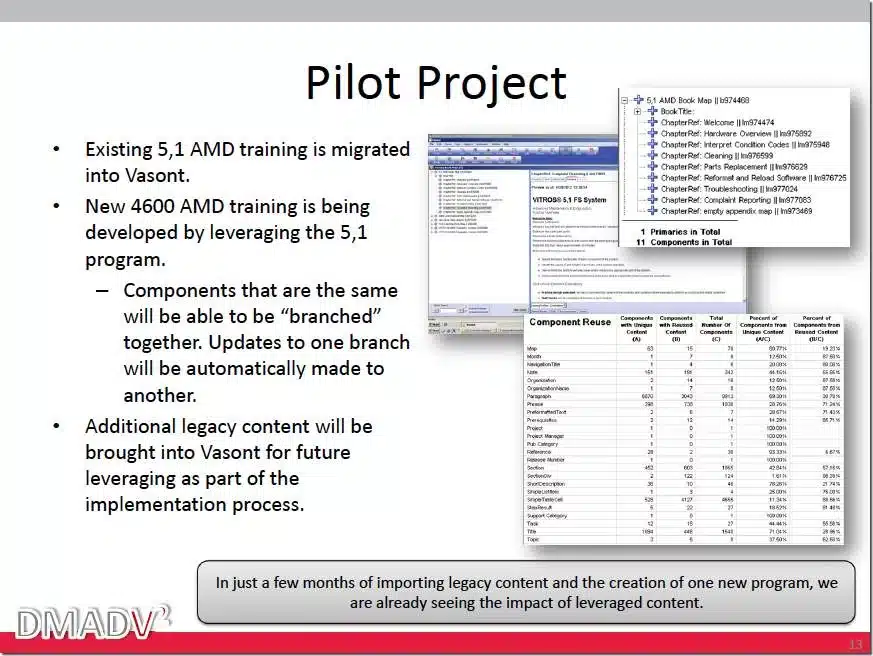
Redesign the content development process. Introduce a single-source, structured content approach that would allow teams to create reusable components rather than repeatedly developing and maintaining separate documents.
Implement the supporting technology and workflows. Identify the appropriate solution and partner with an external vendor and consulting team to translate business requirements into a working content management capability.
I was responsible for identifying the solution and leading the partnership with the implementation team, connecting operational needs with the technical expertise required to deliver the new approach.
The goal was to move beyond improving individual development tasks and establish a repeatable process that could support multiple products, audiences, and languages.
Business Impact
The redesigned content development process delivered measurable results:
85% content reuse in the initial training manual, requiring only 15% new content to be developed, approved, and localized.
More than $250,000 in reported cost savings on a subsequent medical device training initiative, which was delivered on time and under budget.
Support for localization across 17+ languages, reducing the need to maintain separate sources of identical content.
Organizational return on investment in under two years, demonstrating the financial value of the redesigned process.
Following the initial implementation, the organization continued using the approach for additional product training initiatives, supporting different audiences and content formats.
Together, these improvements reduced duplication, strengthened content consistency, and established a more scalable model for global training development.
The result was more than a new content management system. It was a fundamental change in how the organization developed and reused information, creating a sustainable capability that improved efficiency and supported global growth.