
Building Scalable, Accountable Support Operations
How a large organization improved service delivery, operational visibility, and accountability through structured work management.
Project Impact
Centralized
Work Management
Service-Level
Accountability
Operational
Transformation
Overview
Effective support operations depend on more than getting requests completed. Teams need clear processes for managing incoming work, visibility into what’s happening, and a way to measure whether service expectations are being met.
I led the design and implementation of a centralized work management capability supporting multiple marketing teams within a large, distributed organization.
The initiative established structured intake, standardized workflows, service-level agreements (SLAs), and recurring performance reporting, creating a more transparent and accountable operation.
More recently, I applied these same principles to turn around a high-volume creative support queue, reversing its backlog growth trend within four weeks.
The Challenge
Marketing support operations lacked the structure and visibility needed to effectively manage service delivery.
Leadership had limited insight into incoming request volumes, types of work, assignments, and workload distribution.
Without established SLAs or consistent performance reporting, managers struggled to identify delays, understand workload, and maintain accountability to service expectations.
These challenges became particularly visible within the creative support function, where requests were accumulating faster than they were being completed. Internal approvals and requests awaiting customer responses contributed to delays, making it difficult to distinguish work requiring action from work waiting on others.
The opportunity was to create a more structured, measurable operating model that improved oversight without adding unnecessary administrative work.
My Approach
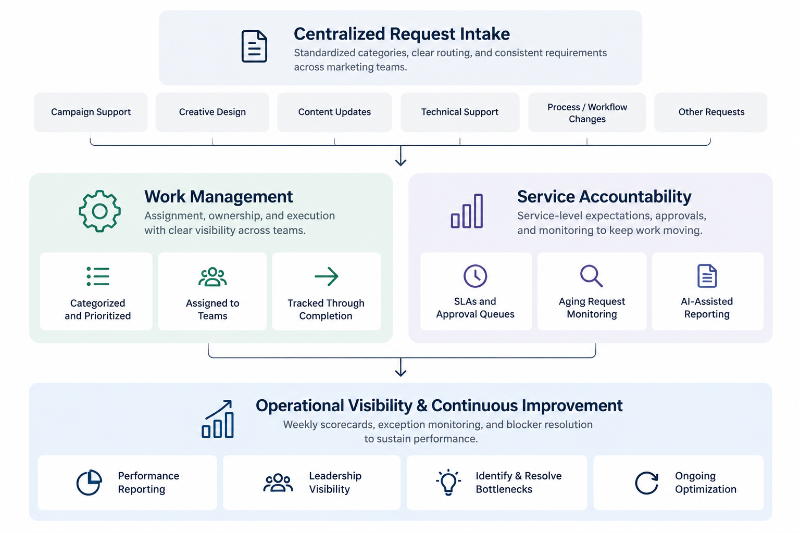
1. Established Centralized Work Management
I designed and implemented a centralized intake and execution model using Jira Service Management.
This included standardizing how requests were submitted, categorized, assigned, and tracked across marketing teams.
The goal wasn’t simply to introduce a ticketing system. It was to establish a consistent way of managing work that gave both individual contributors and leadership a shared understanding of demand, ownership, and progress.
2. Built Service-Level Accountability
I established SLAs and weekly performance scorecards to create clearer expectations around service delivery.
Reporting provided managers with visibility into incoming request volumes, work categories, assignments, and performance against established service levels.
These capabilities shifted operational oversight from relying on individual updates to using consistent, measurable information.
I also incorporated AI-assisted reporting to streamline recurring operational reviews and make it easier to identify requests requiring attention.
3. Turned Around Creative Support Operations
When a high-volume creative support queue came under my ownership, I focused on identifying where work was getting stuck and improving the processes around it.
I built dedicated monitoring queues to surface outstanding requests and introduced stricter SLAs and tracking queues for internal approvals.
I also developed AI-assisted weekly audits to identify aging or potentially stalled tickets, along with follow-up reporting to help individuals address requests awaiting their input.
A project coordinator took responsibility for distributing work and monitoring the queues day to day. My role focused on removing blockers, improving processes, and ensuring the operating model supported the team’s execution.
Within four weeks, the team reversed its backlog growth trend and established a more sustainable approach to managing incoming work.
Business Impact
The transformation established a more transparent and accountable approach to managing support operations.
Improved operational visibility. Centralized reporting gave leadership a consistent view of incoming demand, work ownership, and service performance across teams.
Stronger service-level accountability. Established SLAs and weekly scorecards created measurable expectations and a regular mechanism for reviewing performance.
Improved creative support performance. Within four weeks, the team reversed its backlog growth trend through better monitoring, approval accountability, and follow-through.
More sustainable execution. Clear ownership, recurring reporting, and AI-assisted exception monitoring made it easier to identify stalled work and manage daily operations without relying on constant leadership intervention.
The result was a more measurable, manageable support operation, with stronger accountability and a repeatable approach to identifying and resolving operational bottlenecks.